
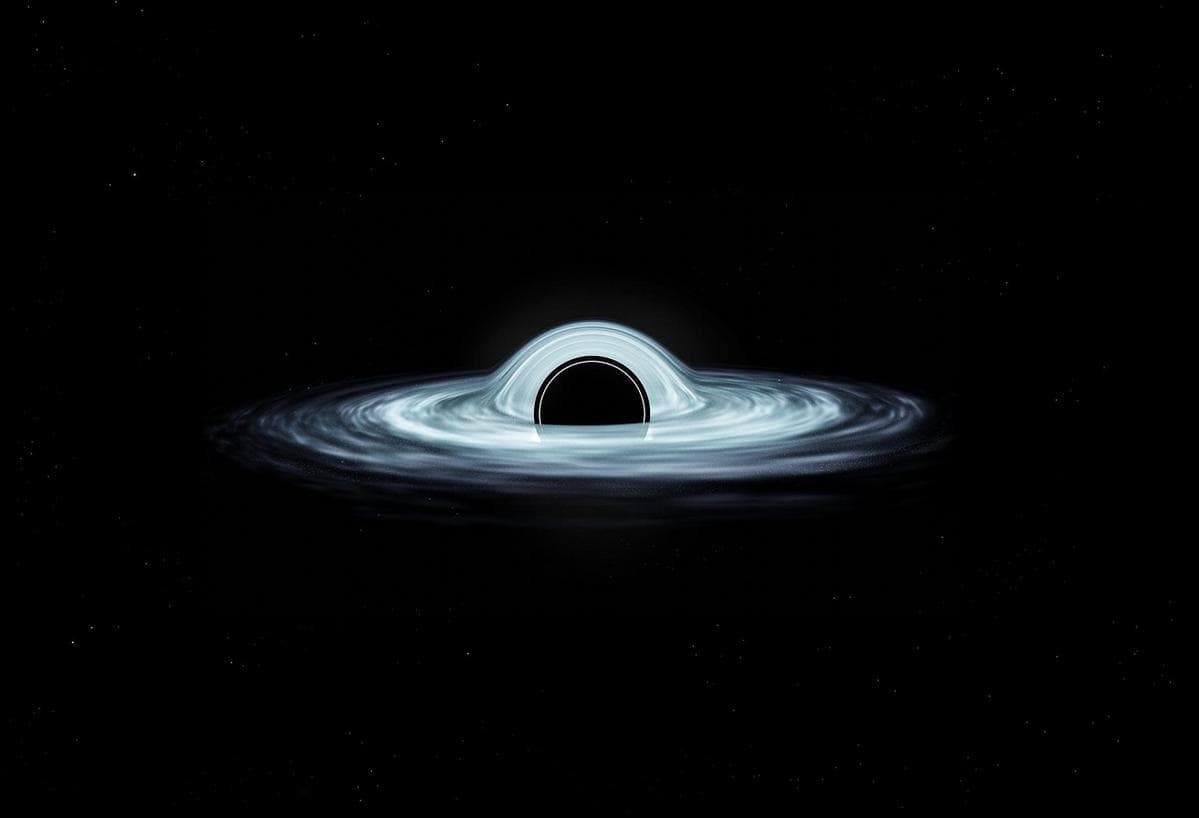
Astronomers have applied a deep learning model—trained on millions of simulated supermassive black hole scenarios—to data from our galaxy’s core, concluding that Sagittarius A*, the Milky Way’s central black hole, spins at nearly its maximum rate.
Even with powerful radio telescope arrays, researchers struggle to capture every detail of these extreme objects. The Event Horizon Telescope (EHT) links radio dishes around the globe into a single instrument that maps the radio wave emissions encircling black holes. It delivered the first ring-like visuals of M87* and Sagittarius A*, yet much raw information never made it into the final renderings.
When the EHT records signals, supercomputers worldwide combine the streams to produce the familiar shadowed centers and bright rings. During that processing, a large portion of the data proved difficult to interpret and was set aside. Scientists at the Morgridge Research Institute in Wisconsin developed a neural network to mine those unused signals, boosting effective resolution and opening fresh investigative paths.
A press release from the institute reports that the AI parsed the overlooked streams and set new constraints on Sagittarius A*, which sits about 26,000 light-years from Earth. The system produced an alternative depiction of the black hole’s surroundings, highlighting features of its glowing ring and the flow of material in orbit.
“Researchers now suspect that the black hole at the center of the Milky Way is spinning at almost top speed,” wrote the researchers in a press release. The newly generated image suggests that Sagittarius A*’s spin axis points almost directly toward our planet. Those geometrical insights may explain how the accretion disk of hot gas and dust feeds the dark core.
Earlier studies placed this supermassive black hole’s spin rate in a moderate to fast range. Pinpointing the exact angular velocity is critical for modeling the radiation patterns near the event horizon and gauging the hole’s stability under intense gravitational forces.
“That we are defying the prevailing theory is of course exciting,” lead researcher Michael Janssen, of Radboud University Nijmegen in the Netherlands, said in the press release. “However, I see our AI and machine learning approach primarily as a first step. Next, we will improve and extend the associated models and simulations.”
The team plans to refine its training sets and expand the neural network to process additional EHT data. By combining updated simulations with real observations, researchers aim to achieve an even clearer portrait of black hole dynamics at our galaxy’s heart.