Ever wondered how one AI can juggle words, images, audio, and video in a single moment – and still nail the perfect answer? That’s Google Gemini. It hit the scene in December 2023 after a team-up between Google Brain and DeepMind.
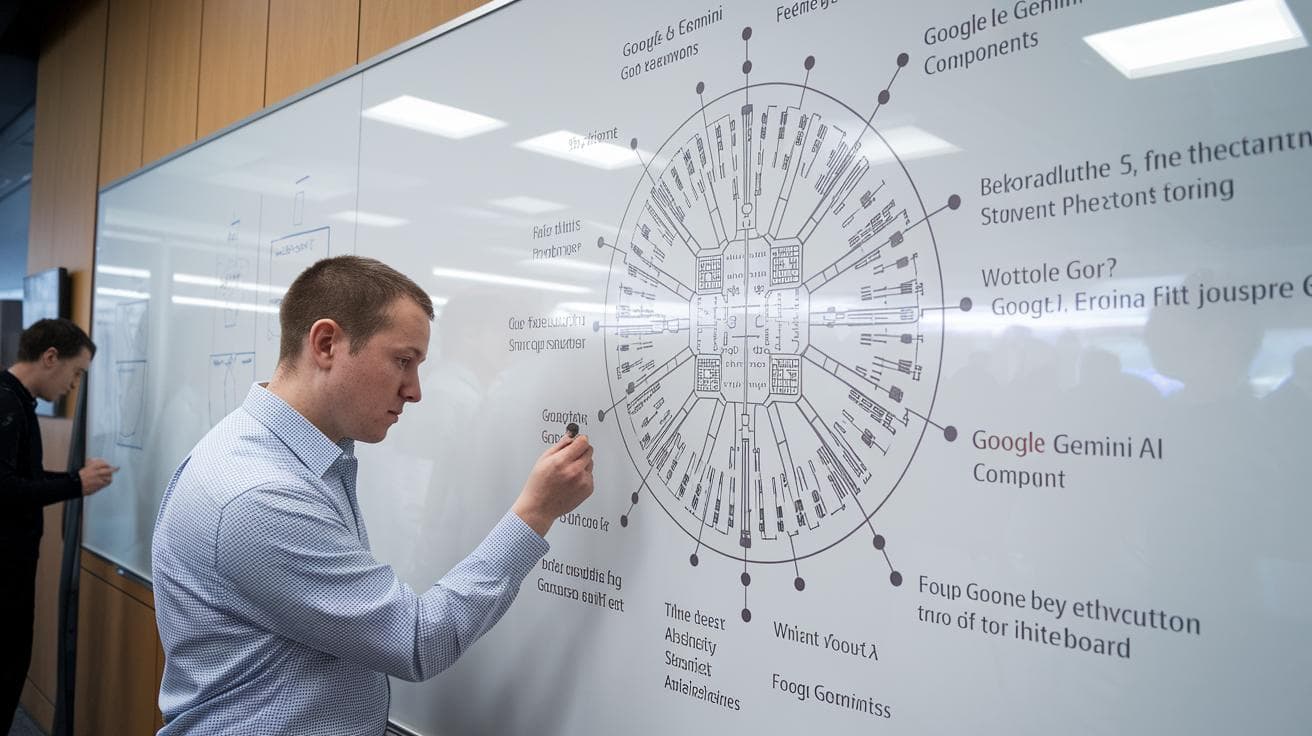
Imagine its design like colorful Lego bricks clicking together. Each brick encodes your input (turns it into a format the AI can read), blends different data streams through cross-modal attention (a slick way to mix words, pics, and sounds), and finally decodes everything into a clear output.
Ready to peek under the hood? We’ll start at Gemini’s encoder front door, swing by the cross-modal fusion party, and end at its decoding center. By the time we’re done, you’ll see how tiny pieces of info come together for a rich, seamless understanding.
Comprehensive Architectural Layers in Google Gemini AI Architecture

Google Gemini first arrived in December 2023 when Google’s CEO and leaders from DeepMind and Brain AI labs introduced it. Have you ever seen one system that can read text, look at images, listen to audio, and watch video all in one go? That’s Gemini. There are three versions – Ultra for heavy thinking in Bard Advanced, Pro for middle ground, and Nano for on-device tricks on Pixel phones. Gemini turns pictures into discrete image tokens (tiny data pieces) and taps the Universal Speech Model (a way to handle human voice) for silky smooth audio. It’s fully multimodal – it works with text, images, audio, and video all in one.
Under the hood, Gemini works like a set of Lego blocks. Each block has its own job – encoding to get data ready, fusion to blend it, and decoding to make an answer. Splitting things up lets engineers fine-tune each part on its own. Want to tweak images? You can do that without touching the audio. And it keeps the encoder (the reader) and decoder (the writer or drawer) talking closely so you get both deep reasoning and lean work on your device.
Multimodal Encoder
The encoder is the front door for data. Text is tokenized (split into words or parts) and then embedded (turned into numbers the model reads). Images get sliced into patches – each patch becomes a token too. Audio uses the Universal Speech Model to change sound waves into embeddings (yep, numbers again). Video is just a sequence of frames like a flipbook, plus any audio or subtitles. Before fusion, each stream is smoothed and embedded so all data speaks the same language.
Cross-Modal Attention Network
Next up is the fusion party. A stack of multi-head cross-attention layers (many attention helpers) sit around and share info. Text can nudge image analysis, audio can add flavor to video – you name it. This lets Gemini do cool things like compare objects in a photo while following someone’s narration. In reality, it’s where the model’s magic and complex reasoning come alive.
Multimodal Decoder
Finally, the decoder jumps in to craft your result. For text, a language head completes the sentences. For images, discrete tokens paint pixels one patch at a time. Code modules write programming lines following syntax rules. And audio is sent through a vocoder (a tool that turns embeddings back into real speech) so you get a natural voice. It’s like the smooth hum of a well-oiled machine!
Data Ingestion and Preprocessing Workflow for Google Gemini

Ever wonder how an AI soaks up all kinds of data? Gemini starts by gathering a massive collection of web pages, e-books, code snippets, images, audio clips, and video scenes. It taps into different sources and languages, so it can spot patterns that work across tasks, from understanding a rare dialect to recognizing a fresh illustration style. And because we track and label every file, the whole workflow stays transparent and reproducible.
Every raw file then goes through three key steps: extraction (pulling out the bits we need), cleaning (zapping noise and duplicates), and tokenization (breaking text into tokens – tiny pieces of language). For code, we use syntax-aware tools that trim comments and preserve indent structure. Images are resized to a uniform grid, normalized for brightness and color, and sliced into fixed-size patches. Audio clips get sampled, background hiss is reduced, and they’re turned into embeddings (numeric summaries) by the Universal Speech Model. Video gets even cooler: we break it into frames, sync up subtitles or audio streams, and embed everything into a shared vector space.
Next comes training with self-supervised tasks. One trick is masked modeling, where random words, image patches, or sound segments are hidden and then guessed, kind of like filling in the blanks. We also use retrieval-augmented signals, pulling in relevant snippets across text, visuals, and audio to help the model make connections – imagine matching a video clip to a helpful web passage. These techniques nudge the AI to learn context naturally, rather than just memorizing examples.
Then we bring it all together with a unified loss function (think of it as the overall score that guides learning). This score aligns visual, textual, and audio embeddings into one big multimodal understanding. The result? A smooth, efficient pipeline that powers Google Gemini’s ability to learn from anything and adapt to brand-new challenges. You could almost hear the quiet hum of innovation behind it.
Training Infrastructure and TPU Integration in Gemini Architecture

Inside Google data centers, TPU pod slices hum together like a well-rehearsed band on stage. Each slice connects dozens of TPU chips with a super-fast network that moves data almost instantly. At the core, custom performance kernels fine-tune every operation, squeezing out more speed than you might expect. Engineers match these kernels to Gemini’s huge transformer layers, so the heavy matrix math runs with surgical precision.
Then comes mixed-precision training. It’s like mixing different paint colors, but for math. The model uses lower-precision formats (for example, bfloat16 (a number format that’s smaller but still accurate)) most of the time, then switches to higher-precision steps when it really counts. That blend speeds up gradient updates without losing accuracy. And with kernel fusion, multiple tasks, loading, computing, storing, happen in one smooth pass. You can almost feel the memory bandwidth lighten up.
We’ve got two main hardware flavors: Pro and Nano. Pro balances TPU compute and memory across a wider pod slice. It breezes through large context windows and heavy multimodal pipelines. Nano is more lightweight. It uses 4-bit quantization (tiny data packing) to shrink models for on-device use, like a Pixel phone or an edge server. You give up a bit of numerical precision, but you get massive gains in speed and energy efficiency.
Here are the key pieces under the hood:
- TPU pod slices and network topology
- Tensor and pipeline parallel execution
- Distributed optimizer strategies
- Memory footprint analysis
- Quantization scheme evaluation
Inference Engine and Optimization Techniques in Google Gemini

Google Cloud Vertex is like the engine room for Gemini’s inference. Inference is just the part that turns your prompt into an answer. We wrap each model in a container (think of it as a lunchbox for software) and ship it off to Vertex AI endpoints. Those endpoints can fire up GPU nodes (graphics chips that crunch data) or TPU nodes (custom AI chips) in a snap. One moment you’re on a handful of servers, the next you’ve got a full fleet humming away, no more waiting on big image or video jobs. And if you want to plug Gemini into your own code, check out how to integrate Google Gemini AI with Python applications. It walks you through setting up endpoints, scaling your API, and handling failover when things go sideways.
Inside, Gemini uses some neat tricks to keep responses lightning-fast. Multimodal means it handles text, images, and audio all at once. Send a question, and a transformer model (a smart reader that turns words into codes) grabs text embeddings (secret recipes for words) and spins out tokens, the building blocks of an answer. For images, it spits out image tokens, kind of like puzzle pieces, ready to render. Your voice? It flows through the Universal Speech Model (a fancy transformer for sound) that converts embeddings into waveforms you can actually hear, all in real time.
To cut down on gears grinding, Gemini caches common embeddings and fuses operations on the data graph, that’s just fancy speak for merging steps. And dynamic quantization quietly lowers number precision on repeat calls so responses pop back faster without you noticing any dip in quality.
Security is tight around here. Vertex AI’s access controls are like a bouncer at the club door. Role-based policies let you choose who can send requests, and service accounts (special software IDs) get their own read, write, or admin passes. You also get rate limits per key so nobody can slam your system with traffic, plus quotas per endpoint to keep cloud bills in check.
Want to roll out a new model? Versioning support lets you split traffic, send some users to your latest tweaks while others stay on the old version. And every single prediction is logged. Audit logs are basically a replay button, so you can spot anything odd or fix performance hiccups.
Scalability and Deployment Patterns for Google Gemini Architecture

Have you ever wondered how giant AI models keep running smoothly, even when millions of people use them at once? Gemini runs on Google Cloud in containers. Each part (text, image, audio, and video) lives in its own Docker container (think of a sturdy box keeping your code safe). Then microservices orchestration (an automated process that starts or stops containers) adjusts these boxes up or down as demand shifts. So Bard, Search, Ads, Duet AI, and AI Studio can all grab what they need without stepping on each other’s toes. It’s like a row of vending machines that pop open your favorite snack just when you want it.
Under the hood, Kubernetes acts as a smart traffic director. It watches CPU, memory, and custom tags, then places pods (small teams of containers) on the right nodes (the virtual machines doing the heavy lifting). Pods can run different versions: Gemini Ultra, Pro, or Nano. The network connects pods with low-latency virtual routers (fast software pathways). Data glides smoothly between tasks. Resource policies make sure giant jobs don’t hog the party while real-time requests jump the line, so your video analysis or code generation never has to wait too long.
Security stays tight with role-based access controls. Only the right people can call each microservice. We also use an observability stack (tools that watch performance and health) with metrics (numbers on speed and volume), tracing (following each request’s path), and log aggregation (collecting logs in one place). It’s easy to spot latency, errors, and throughput at a glance. Plus, health-check endpoints ping every container. If one goes silent, Kubernetes spins up a fresh pod in seconds.
Performance Benchmarks and Evaluation Metrics of Gemini Architecture

Gemini Ultra raises the bar on tests and coding puzzles. Just take a peek at Google Gemini AI performance benchmarks: it nails 90.04% on the MMLU test (a big quiz covering 57 subjects), 94.4% on GSM8K (grade-school math problems), 74.4% on HumanEval (Python coding challenges), and 82.4% on DROP (reading comprehension tasks). It outshines GPT-4 in most of these areas. Pretty cool, huh?
| Benchmark | Score | Comparison to GPT-4 |
|---|---|---|
| MMLU (57 subjects) | 90.04% | +3.2% |
| GSM8K (grade-school math) | 94.4% | +2.7% |
| HumanEval (Python coding) | 74.4% | +1.5% |
| DROP (reading comprehension) | 82.4% | +4.6% |
| Summary Trade-Offs | High accuracy | Better speed-cost balance |
But here is the thing: lab scores feel great, but real-time use is a different story. You have to balance how many words the model can process per second (that is throughput) with the cost of running it. Throughput tests show steady token-per-second rates. And when you look at performance profiling (measuring how much compute power and money each answer costs), you see a trade-off. Higher accuracy can slow things down a bit.
Next, think about tweaking shard sizes (splitting the workload into smaller chunks) and caching common embeddings (storing frequent data patterns so we do not recalculate them each time). It is like tuning an engine. Small adjustments that let you feel the smooth hum of real-time AI answers without blowing your budget.
Real-World Use Cases Demonstrating Gemini’s Architectural Strengths

Ever found yourself scratching out physics equations and wishing for a cleaner version? Gemini can read your shaky handwriting and follow every step. It feels like you can almost hear the smooth hum of advanced gears turning as it works. It uses spatial reasoning (figuring out shapes and layouts) and long-range dependency modeling (tracking each part of a multi-step problem) to spot symbols and link your calculations. Then it retypes the answer in crisp, classroom-style notation. Students get instant feedback on unit conversions or algebra mistakes.
AlphaCode 2 is the secret weapon for coders in programming contests. By using a contrastive learning signal (comparing and scoring different solutions), it filters out bugs and picks the best approach. Give it a coding challenge, say, sorting algorithms or tricky data structures, and it writes Python or C++ code. Then it runs virtual test cases, spots errors, and tweaks the solution until it’s solid. Pretty cool, right?
Multimodal content teams love Gemini for making text, images, and audio work together. Writers can draft a blog post, then ask Gemini for matching illustrations and an audio summary all in one go. It taps retrieval-augmented generation (fetching related examples from its knowledge vault) to blend everything smoothly. The process feels like a single, well-oiled machine turning rough ideas into polished multimedia.
And big companies use Gemini by fine-tuning the model on their own data, legal contracts, product specs, or medical records. This helps the AI learn industry jargon and follow rules, while Vertex’s enterprise-grade security keeps everything private. Then they roll out APIs that give fast, brand-safe answers for their apps and services. Easy to set up. Ready to scale.
Future Architecture Roadmap and Optimization Strategies for Google Gemini

Gemini 1.5 Pro now uses a mixture-of-experts design. It picks the right expert modules for each task, like choosing the best tool from a smart toolbox. This makes it easy to scale up to massive context windows – from 128,000 tokens to an experimental 1 million – without skipping a beat. You can almost hear the quiet hum as prompt snippets zoom to the experts that know them best.
Have you ever wondered how fast responses happen? The teams are building an end-to-end latency model – a system that measures every millisecond from input encoding (how your words turn into data) to output rendering (how answers show up on your screen). They’re testing micro-batch scheduling (splitting work into tiny chunks), smarter memory reuse (like refilling the same container), and layered caching (stacking quick-access storage). By tuning these parts, they’re tightening feedback loops like a relay race handoff.
The goal is simple: keep replies lightning-fast without sending compute costs sky-high.
Next, Gemini is getting more flexible. It’s testing dynamic resource scaling – imagine a rubber band that stretches when you pull – with predictive autoscaling rules based on real-time load and task mix. So it ramps up when things get busy and cools down when demand drops. This helps keep performance steady without wasting resources.
In reality, power needs guardrails. We run red-teaming exercises (where testers hunt for weak spots), compliance audits (to stick to the rules), and fine-grained role-based policies (only the right people have the right access). These steps keep Gemini safe and on-policy. That way, it’s always ready for enterprise and research challenges.
Final Words
We jumped right into Gemini’s core layers, showing how its multimodal encoder, cross-modal attention network, and decoder unite. Then we walked through data ingestion, TPU-powered training, inference endpoints, containerized deployment, and real-world use cases.
Next we compared performance benchmarks and peeked at the future roadmap, Mixture-of-Experts, expanded context windows, and dynamic scaling.
This architectural overview of Google Gemini AI architecture keeps every detail actionable, letting you feel confident pushing your campaigns forward with AI-driven automation. Exciting times ahead.
FAQ
What is the architecture of Google Gemini AI?
The architecture of Google Gemini AI uses a modular transformer design with a multimodal encoder, cross-modal attention network, and multimodal decoder built by DeepMind and Brain teams to handle text, images, audio, and video.
What is Gemini AI built on?
Gemini AI is built on Google’s unified DeepMind and Brain AI labs infrastructure, running on Tensor Processing Units (TPUs) with custom kernels and mixed-precision training for scalable multimodal performance.
What is an overview of Google Gemini?
An overview of Google Gemini describes a family of large multimodal models introduced in December 2023 that process text, images, audio, and video, available in Ultra, Pro, and Nano tiers.
Does Gemini use GPT architecture?
Gemini does not use GPT architecture; it uses a custom transformer design with cross-modal attention and separate encoder–decoder modules for multimodal understanding and generation.
What is the pricing for Gemini 1.5 Pro?
The pricing for Gemini 1.5 Pro is usage-based through Google Cloud Vertex AI, billed by token or API call; check the Google Cloud pricing page for exact rates and trial options.
When was Gemini 1.5 Pro released?
Gemini 1.5 Pro was released in June 2024, bringing enhanced mixture-of-experts support, extended context handling, and optimized performance over the initial Gemini 1.0 launch.
What API options exist for Gemini 1.5 and 1.5 Pro?
Gemini 1.5 and 1.5 Pro offer REST and gRPC endpoints via Google Cloud Vertex AI, supporting text, image, and audio inputs with built-in scaling, security controls, and versioning.
Is Gemini 1.5 Pro free?
Gemini 1.5 Pro is not free; it uses a paid, usage-based model on Google Cloud Vertex AI, though new users can start with a free trial credit.
What is Gemini 1.5 Pro 002?
Gemini 1.5 Pro 002 is the second checkpoint of the 1.5 Pro model, featuring optimized inference speeds, updated safety filters, and refined mixture-of-experts routing for smoother performance.
What is Gemini 1.5 Pro Deep Research?
Gemini 1.5 Pro Deep Research is a research-focused variant offering extended context windows, advanced in-context learning, and customizable pipelines ideal for academic and lab environments.
How does Google Gemini compare to NotebookLM, Microsoft Copilot, Claude, Google Ads, and Grok?
Google Gemini delivers full multimodal AI, unlike NotebookLM or Grok’s text-only models, adds deeper coding and writing assistance than Microsoft Copilot, and integrates tighter with Google Ads and Claude services.